SPY +0.95%; 22 breakouts vs. 56 failures across 124 setups, UBER selected
Market recap, bot performance, and scanner analysis for Tuesday, May 05.
Breadth improved, but follow-through was still selective
The tape was green. The setup quality was not.
Tuesday was a risk-on session on the surface. QQQ led with a 1.65% gain, IWM kept pace at 1.60%, and SPY added 0.95%. That is a healthy index print, especially with small caps participating. But underneath that headline move, the scanner still found far more disappointment than confirmation. Out of 124 total setups, only 22 resolved as breakouts, while 56 failed and 17 simply expired. That is not the profile of a clean trend day with broad tactical opportunity. It is the profile of a market where the indices moved better than the average setup did.
The grade distribution tells the same story. There were only 11 A-grade setups across the entire universe, despite a bullish skew of 76 long candidates versus 48 shorts. In other words, there was plenty of directional bias, but not enough truly elite structure behind it. That matters. When the market rallies and still produces a weak conversion rate from setup to breakout, traders chasing strength without selectivity usually end up subsidizing everyone else’s exits.
Today worked if you were in the right names and in the right pockets of leadership. It did not work if you assumed a green index tape automatically meant broad momentum. The scanner was right to stay selective, and the bot results showed exactly what happens when execution quality slips. One strong winner was not enough to offset repeated low-quality re-entries in the same ticker.
UBER got the nod because the backtest mattered more than the story
Verdict: trade_it
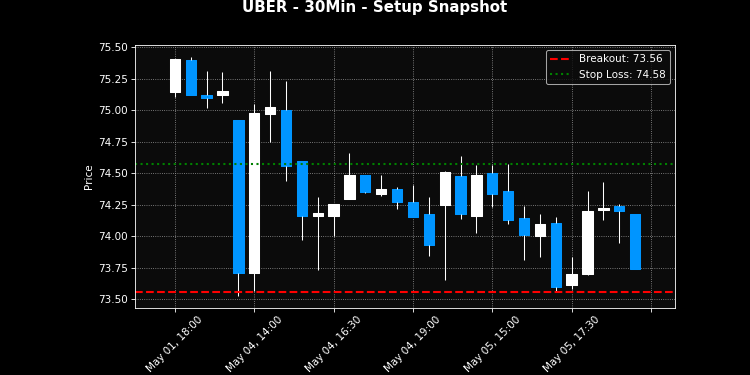
UBER was selected over flashier alternatives for one simple reason: it had actual evidence behind it. SPOT carried an A+ grade, but the statistical backing was thin, with only two backtest trades and no demonstrated edge. APP had bullish appeal, but the setup lacked tested reliability. UBER’s A- bear setup was not perfect, but it was real: 85.71% win rate, 5.03 profit factor, and seven historical trades.
Execution context also favored UBER. The setup sat just 0.63% from trigger, with bearish alignment on the 5-minute, 30-minute, and 4-hour timeframes. That is cleaner than forcing a trade into an unproven long. The fundamental and news backdrop was not ideal for a short, with Santander financing and Europe fleet expansion adding support to the narrative, but this system is about tested edge first and headlines second. That was the right hierarchy.
Wex stayed out. Xcel overtraded one symbol.
There is no elegant way to say it: today was a case study in why not trading can be the best decision on the board. Wex executed zero trades. That is not inactivity for its own sake. That is discipline. If the right conditions are not there, preserving capital is a winning action.
Xcel took five trades, all in PFE on the bear side. One winner posted +7.7%, but the other four lost -11.8%, -7.9%, -8.1%, and -5.3%. The pattern is obvious. The exit engine kept cutting failed momentum quickly, which is correct in principle, but the repeated attempts in the same name created a death-by-a-thousand-cuts outcome. Fast exits are useful. Repeated low-conviction re-engagement is not.
Wex
Xcel
Bottom line: Xcel’s exits did their job. The entries did not. One winner cannot carry four repeated failed shots in the same ticker, especially in short-dated options where time decay amplifies every mistake.
More setups failed than worked, by a wide margin
The headline market move looked healthy, but the scorecard did not. Failures outnumbered breakouts by more than two to one. That is not random noise. It means traders had to be unusually picky with entries and even more ruthless with exits. Broadly bullish conditions did not translate into broadly tradable conditions.
Notable names that did break out included AMAT on a B+ bull setup, AMZN on an A bull, and CSCO, DUK, and FSLY on A- bull setups. GIS stood out on the other side with an A- bear breakout. That list says a lot. Leadership existed, but it was selective and spread across very different groups rather than concentrated in one obvious momentum lane.
Key read: this was an index-friendly session, not a setup-friendly session. Those are not the same thing, and traders who confuse them usually overtrade.
The market rallied, but relative leadership was narrow
Energy remains the clear relative strength leader on a 5-day basis, outperforming SPY by 4.22%. Everything else ranges from flat to outright weak. Biotech and semis were roughly in line, but neither showed decisive relative leadership. That is notable because QQQ had a strong session, yet semis still lagged SPY on a relative basis over the last week. That is not ideal if you are looking for durable tech expansion.
On the weak side, housing and gold continue to get hit hard versus the index, while retail, materials, and metals are also trailing badly. This is not broad cyclical dominance. It is a market picking spots and ignoring the rest. That kind of narrow strength can persist, but it usually punishes lazy sector rotation trades.
Tomorrow’s question is simple: can the setups catch up to the indices?
The next session matters less for the index close and more for confirmation under the surface. If SPY, QQQ, and IWM hold gains while breakout conversion improves, then today’s strength was constructive consolidation rather than a misleading headline move. If the indices stay green but the scanner continues producing more failures than breakouts, that is a warning sign that traders are running on index beta, not stock-level edge.
Watch whether A-grade setup count expands from today’s low base of 11. That number needs to improve. Also watch whether leadership broadens beyond isolated pockets like energy and a handful of one-off breakouts. For the bots, the lesson is straightforward. Wex’s patience is worth preserving. Xcel needs cleaner selectivity and less repetition in the same symbol. Fast exits are necessary, but they do not excuse bad clustering.
Tomorrow is about quality control. The market gave traders green screens today. It did not give them much forgiveness.