SPY +1.45% as 20 of 93 setups broke out; SPOT was the pick
Market recap, bot performance, and scanner analysis for Wednesday, May 06.
Breadth was green. Selectivity still mattered.
Risk-on session, but not a clean trader's paradise
The index message was simple: buyers had control. QQQ led with a +2.28% move, SPY and IWM both added roughly one and a half percent, and the tape rewarded long exposure more often than short aggression. But the internals under the scanner were less impressive than the headline indices suggest. Out of 93 setups, only 20 resolved into breakouts while 46 failed. That is not broad-based efficiency. That is a strong market with a lot of mediocre individual execution.
The split leaned bullish at 55 bulls versus 38 bears, which matched the index action, but the grade distribution also told the real story. There was only one A++ and just eight A-grade names total. So yes, the market ripped, but truly high-confidence opportunity was still scarce. Some of the best movers came from names and ETFs that kept grinding after the open rather than exploding out of perfect textbook triggers. That matters because it explains why the session looked better on a chart than it did inside a rules-based execution framework.
Notable breakout names included BMY on the short side, plus CEG, CELH, and DIA on the long side. IBM also broke lower. The mixed list reinforces the point: this was not a one-theme day. It was a momentum day with pockets of follow-through, and if you were overfiltered you missed runners. If you were underfiltered, you probably got chopped with everyone else in the 46 failures.
No pick, and that was the right call
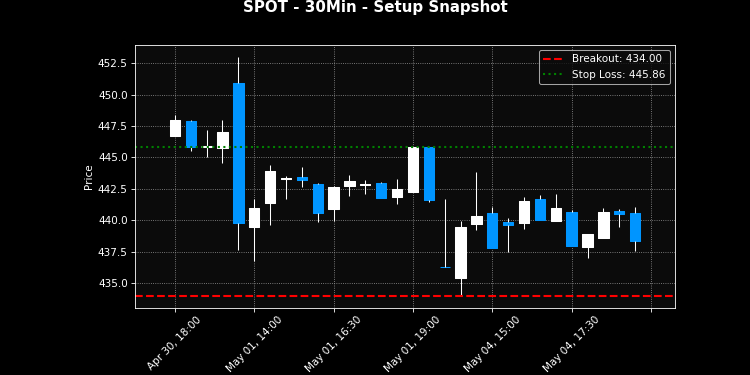
Arxe flagged SPOT as the highest-graded setup at A+, then passed on it. The reason was straightforward: the backtest was statistically useless. Two historical trades, 50% win rate, 1.0 profit factor. That is not edge. That is noise.
ADBE and TSLA had slightly deeper samples, but both showed negative expectancy, so there was no grade A or better setup with proven positive edge. External context did not improve the case. Recent analyst price-target cuts from UBS and JP Morgan created some noise, but there was no clear company-specific breakdown catalyst and no strong directional news skew. In other words, the chart looked interesting, the data did not confirm it, and the system stayed out.
That discipline matters. Skipping an attractive chart with weak evidence is not missed opportunity by default. It is process integrity. The market gave enough other names to regret that decision emotionally, but none of that changes the underlying logic.
Light activity, modest output, plenty left on the table
Wex
Wex did not execute a single trade. In a day where the major indices were firmly green and several clean bullish continuations worked, zero participation stands out. It may reflect proper filtering, but from a portfolio contribution standpoint it was a non-event.
Xcel
Xcel took two bullish options trades and finished with one scratch and one small gain. That is defensible, but not impressive given the market backdrop. The bigger issue is not what Xcel lost. It is what it failed to capture.
The opportunity cost was real
The bots traded 2 breakouts and missed 14. The missed basket totaled +14.55R. Two of those were full TP3 runners. Two more reached TP2. One hit TP1. This was not a case of one freak outlier skewing the report. There were multiple clean follow-through names the framework did not capture.
Some misses were acceptable. JNJ and ROKU had weak relative volume, and IBM was a smaller half-R type short that does not justify loosening standards by itself. But DIA, XLI, ORCL, and MS are harder to dismiss. Those are the kinds of names that point to a genuine blind spot when a market lifts broad index exposure and cyclical participation at the same time.
Grade A | +4.78R | TP3 full runner
RVOL 2.24x | Day +1.47%
This is the cleanest miss on the sheet. Strong volume, strong index alignment, full extension. Hard to defend missing it.
Grade A- | +3.85R | TP3 full runner
RVOL 1.29x | Day +2.73%
Another broad beta confirmation trade that got away. More evidence that the framework did not lean hard enough into index-backed strength.
Grade A- | +2.46R | TP2
RVOL 1.0x | Day +2.53%
Lower urgency on volume, but the move still delivered. This is a gray-zone miss, not an obvious error.
Grade A | +2.32R | TP2
RVOL 1.77x | Day +6.99%
Serious move with real participation. This one belongs in the blind-spot category, not the acceptable-filter category.
Grade A | +1.14R | TP1
RVOL 1.0x | Day +1.55%
Reasonable miss. It worked, but not enough to rewrite filters around it.
Grade A- | +0.76R | Minor
RVOL 0.25x | Day -0.39%
Low-volume short. Missing this is probably correct behavior.
Grade A- | +0.56R | Minor
RVOL 0.15x | Day +0.46%
Another miss that should not trigger any soul-searching. Weak confirmation.
Grade A- | +0.50R | Minor
RVOL 0.95x | Day -1.94%
Worked modestly on the short side. Fine to acknowledge, not a painful omission.
The scanner found movement. It did not find consistency.
A 30.3% breakout rate is not strong enough to justify loose aggression. Most setups did not work. That is why discretion and evidence thresholds still mattered even in a rising tape.
The names worth remembering are the ones that either aligned tightly with macro direction or showed clear independent momentum: DIA, CEG, CELH, and ORCL on the long side, plus BMY and IBM on the short side. What stands out is that several notable winners came from higher-grade names, but the overall pool still had too much failure to blindly trust the scanner.
Energy kept leading. Defensive hard assets kept lagging.
Energy
+4.22% vs SPY over 5d
Biotech
-0.05% vs SPY over 5d
Semis
-0.30% vs SPY over 5d
Retail
-2.32% vs SPY over 5d
Materials
-2.58% vs SPY over 5d
Metals
-3.10% vs SPY over 5d
Housing
-6.85% vs SPY over 5d
Gold
-7.90% vs SPY over 5d
Energy remains the standout relative-strength group, outperforming SPY by more than four points over the last five sessions. That is real leadership. Biotech and semis were roughly in line, which is notable because QQQ itself had a strong day. The lagging groups remain retail, materials, metals, housing, and especially gold. That is a clear risk-on rotation signature: less appetite for defense, more appetite for growth and economically sensitive exposure.
Tomorrow is about whether broad strength can convert into cleaner setup quality
The main question for the next session is simple: does today's index strength create better follow-through candidates, or does it just leave traders chasing extended names after a sloppy scanner day? If the market stays bid, watch for continuation in broad beta vehicles and industrial cyclicals. DIA and XLI already showed the template.
Second, keep an eye on whether tech leadership can hold without becoming overcrowded. QQQ outperformed materially, but semis have still underperformed SPY over the last five days. That divergence matters. If semis re-accelerate, bullish momentum gets broader and healthier. If they continue lagging, the index move becomes narrower than the headline suggests.
Finally, the bot review is straightforward. The system needs to figure out whether its filters are suppressing too many valid index-aligned longs in strong tape. Missing low-volume noise is fine. Missing DIA, XLI, and ORCL in this environment is a process problem until proven otherwise.