SPY rises 0.81% as 14 of 95 setups break out; CSCO is the pick
Market recap, bot performance, and scanner analysis for Friday, May 08.
Index strength was real, but breadth still looked selective
Friday closed with a straightforward headline: tech carried the tape. QQQ smoked everything else at +2.33%, while SPY and IWM were positive but far less convincing. That matters because the market was up, but not everything was working equally. This was not broad, clean participation. It was a growth-led push with selective follow-through.
The scanner reflected that split. Total setup flow was nearly balanced at 47 bulls and 48 bears, yet the actual resolution count leaned only slightly toward breakouts at 14 versus 13 failures. In plain English, the tape was tradeable, but it was not generous. You still had to be selective, and mediocre entries or weak option structures got punished fast.
Grade quality was solid on paper with 7 A-grade setups out of 95 total, but the actual breakout list was not full of explosive runners. The market gave movement, not a lot of easy money. That distinction is why index strength and bot PnL can diverge on a day like this.
Strong market, mixed execution environment
The cleanest read today was that institutions were willing to bid large-cap growth, especially anything tied to tech leadership. That showed up in QQQ’s outsized move and in names like GOOGL and CSCO staying relevant on the long side. But the breakout board itself was not especially rich. Fourteen breakouts against thirteen failures is basically a coin flip with a slight edge, not a momentum bonanza.
That creates a difficult environment for automated execution. The system can find valid setups, but if option pricing is poor, spreads are messy, or follow-through is slow, decent directional calls still translate into weak realized results. That is exactly what happened in spots today. The market backdrop was constructive, but execution quality was uneven, and the option layer did not forgive hesitation or bad timing.
The other takeaway is that bears were not fully dead. Scanner balance stayed almost perfectly even, and a few downside names still resolved as valid breaks. So while the indices looked bullish, the internal picture was more nuanced. Chasing every green candle would have been lazy analysis and bad trading.
CSCO got the nod for the right reasons, even if the outcome was messy
Verdict: trade_it
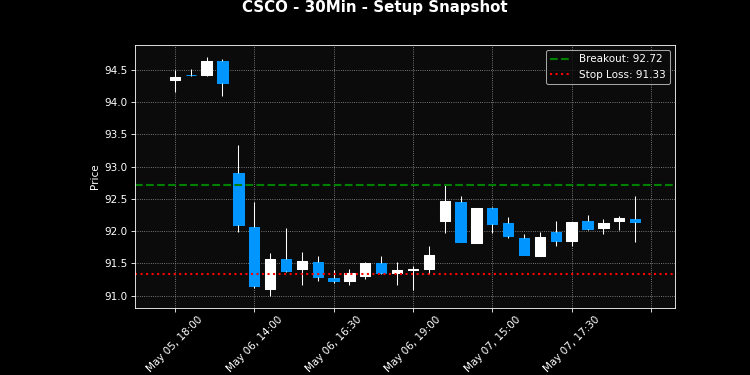
CSCO was the highest-grade actionable setup on the board. It carried an A grade, beat BIDU’s A-, and had a more credible sample than NFLX with 8 backtest trades versus just 1. The edge was not spectacular at a 50.0% win rate and 1.01 profit factor, but it cleared the confidence rule and held the top spot on a thin slate.
External context helped. Evercore ISI maintained Outperform and lifted its price target to $110, which supported the breakout case into 92.72. Earnings on May 13 added event risk, but not enough to disqualify the setup.
Post-pick, CSCO did resolve as one of the day’s notable bullish breakouts. So the selection logic was fine. The problem was execution. Wex logged the trade as a flat result because no broker position was found, which makes it operational noise rather than a market read failure. The pick was right. The capture was not.
Direction was decent. Trade management and option capture were not.
Wex traded three times and the blotter was ugly. One orphaned CSCO trade, one stopped-out winner in GOOGL options despite a strong tape, and one outright bad XLY loss. This is what sloppy translation from signal to position looks like.
Xcel also took three trades, and all three lost money. This was not a case of the tape being impossible. It was a case of the system failing to convert scanner quality into realized edge.
The missed board was not painful, but there was still money left behind
The bots traded 5 breakouts and missed 4. Total missed opportunity came to +1.18R. That is not disastrous, but it is real. More importantly, there were 0 TP3 full runners and 0 TP2 hits. Only one missed trade reached TP1. So this was not a day where the system ignored huge trend moves. The misses were mostly small and arguable.
+1.18R | A- Bull | TP1
RVOL 1.0x | Day % 0.54%
This was the only meaningful miss. Since it reached TP1 and led the missed pack by a wide margin, this leans toward a genuine blind spot rather than a harmless skip.
<div class="bt-card">
  <div class="pick-symbol">DECK</div>
  <p><strong>+0.32R</strong> | B+ Bear | Minor</p>
  <p>RVOL 1.0x | Day % -1.15%</p>
  <p>Not much regret here. Small move, limited payout. Missing this is acceptable if filters were prioritizing higher-quality longs.</p>
</div>

<div class="bt-card">
  <div class="pick-symbol">DHR</div>
  <p><strong>+0.32R</strong> | B Bear | Minor</p>
  <p>RVOL 1.0x | Day % 0.47%</p>
  <p>Another minor miss. Given the grade and limited extension, this looks more like correct selectivity than a process failure.</p>
</div>

<div class="bt-card">
  <div class="pick-symbol">WMT</div>
  <p><strong>+0.27R</strong> | A- Bull | Minor</p>
  <p>RVOL 1.0x | Day % 0.12%</p>
  <p>High grade, but barely moved. No serious damage from passing on it.</p>
</div>
Bottom line: the system did not miss some monster trend day. The one trade worth caring about was CVS. Everything else was noise-level opportunity. That should keep the postmortem focused on execution and option handling, not on broadening filters indiscriminately.
Breakouts barely beat failures, which explains the choppy feel
This was almost a dead-even resolution board. Fourteen breakouts to thirteen failures is not broad momentum. It is a tape where being a little late, a little aggressive, or a little unlucky can be the difference between a decent day and a bad one.
Notable breakouts included BIDU and CSCO on the bull side, plus CVS and FDX as additional upside names that resolved. On the downside, DECK and DHR proved that bearish setups still had a pulse despite the strong index close.
The honest read is that the board supported selective trading, not maximum exposure. That is why the scanner did its job but the actual PnL still disappointed.
Semis kept leading, defensive pockets lagged, gold stayed weak
Semis remain the clean leadership group, outperforming SPY by 4.71% over the last five sessions. That is not subtle. If you are fighting tech leadership right now, you are making the game harder than it needs to be.
Energy also held up well, while biotech was mildly constructive. On the weak side, housing and gold were clear laggards, with retail and materials also trailing. That relative strength map continues to favor growth and away-from-defensive positioning.
Tomorrow’s question is simple: can breadth catch up to tech?
The main thing to watch next session is whether today’s Nasdaq-led move broadens or stalls. If QQQ keeps dragging the tape higher while SPY and IWM stay muted, expect another selective environment where only the best setups deserve capital. If breadth improves, breakout odds should rise from today’s near-coin-flip reading.
CSCO will stay relevant after validating the pick logic, but with earnings approaching on May 13, timing gets tighter and the margin for error shrinks. BIDU also deserves a second look after proving it had real breakout potential despite poor capture from Xcel.
From a process standpoint, tomorrow is less about finding more trades and more about fixing conversion. The scanner is surfacing workable names. The weak link is turning those names into actual, durable PnL.