SPY rises 0.17% as 38 of 116 setups break out, with 27 failures
Market recap, bot performance, and scanner analysis for Monday, May 11.
Index tape was green, but not by much
Today was not a broad risk-on sprint. It was a selective grind higher in the major indexes, with small caps leading by a little and plenty of rotation under the surface. The scanner still found 116 setups, so opportunity was there, but the quality was uneven. Most names needed clean timing, not blind participation. If you want the exact grades and breakout levels, see live setups in the scanner.
The bigger point is that the market gave enough movement to make money, but not enough forgiveness to survive sloppy entries or lazy exits. That showed up clearly in the bot results. Wex stayed mostly functional. Xcel had one ugly loss and one self-inflicted giveback. For context versus recent action, here is yesterday's debrief.
Choppy tape, real dispersion, and a lot of false comfort from green indexes
SPY, QQQ, and IWM all closed positive, but that headline hides how mixed the session actually was. Semis and gold kept showing relative strength over the last five days, while energy remained a dead zone versus the tape. That matters because today's best follow-through came from pockets with either clear momentum or clear defensive sponsorship. The middle of the board was mostly noise.
On the scanner side, 38 breakouts versus 27 failures is decent, not exceptional. The raw count says there was action. The grade mix says there were only 10 true A-grade opportunities, so selectivity still mattered. A lot of the lower-grade flow could move, but not all of it deserved capital. The honest read is simple: this was a trader's market, not an investor's market, and execution quality mattered more than directional genius.
The system also left money on the table. That was not because there were no runners. There were. It was because the filters and timing logic did not capture enough of the session's clean breakouts, especially some commodity and retail names. Some misses were acceptable. A few were not.
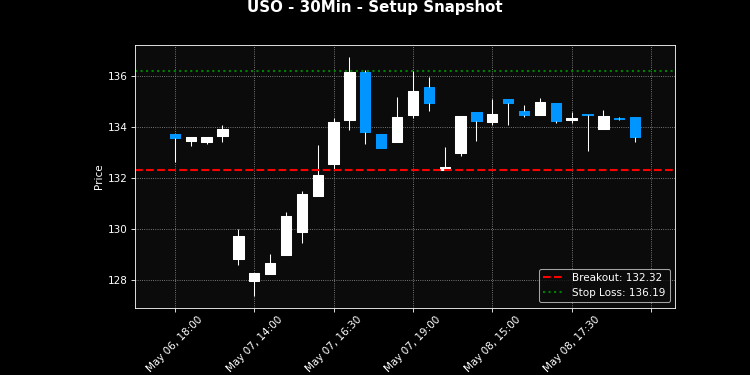
USO got the nod for the right reason
The verdict was trade it. That decision was grounded in process, not story. GLD had the stronger headline grade at A+, but it was disqualified by rule because the backtest sample was only one trade. That is not edge. That is trivia.
USO and CAT both qualified with A grades and three backtest trades each, but USO had the better historical edge at 100% win rate versus CAT at 66.67%. More importantly, the 30-minute and 4-hour trends were both aligned bearish. External oil headlines were mixed enough to keep volatility elevated, but not clean enough to invalidate the downside setup. That made USO the cleaner short-side expression. For live setup grades and breakout levels, see live setups in the scanner.
The underlying call was sound because it respected sample quality, trend alignment, and context. That is what the pick is supposed to do. It is not about choosing the flashiest symbol. It is about choosing the setup with the fewest excuses.
Wex held up. Xcel did not.
There were six bot trades total. The session was good enough to reward disciplined management, but it also punished systems that either exited poorly or sat through option damage. You can watch Wex and Xcel trade live in the Edge Lab if you want to compare today's behavior against the real-time flow.
Wex
Wex finished 3 for 3 on the day. That sounds cleaner than it was, but the result is still respectable. It did not maximize every move, yet it mostly avoided the kind of damage that ruins decent sessions. That matters.
Xcel
Xcel had the kind of day that strips away excuses. One oversized loser is bad enough. Letting a high-conviction winner reverse from +59% peak to a loss is worse because it suggests the exit engine did not do its job when it mattered. Again, watch Wex and Xcel trade live in the Edge Lab if you want to see how those decisions unfold in real time.
The bots left 20.95R on the table
Six breakout trades were taken. Twenty-two were missed. The missed basket added up to +20.95R, including two full TP3 runners. That is not trivial leakage. Some of these misses were acceptable because they sat in lower-quality territory or lacked the kind of volume confirmation the filters are designed to demand. But a few were genuine blind spots, especially where grade and RVOL were both strong. For the live board of setups and levels, see live setups in the scanner.
A- setup, +6.16R, TP3 full runner, RVOL 1.96x
This is a real miss. Good grade, good volume, clean metals strength backdrop. Hard to justify not participating somewhere in the stack.
B setup, +3.98R, TP3 full runner, RVOL 2.31x
Less painful than SLV because the grade was only B, but the volume was real and the follow-through was undeniable. This is the kind of move a strict quality filter can miss by design.
A- setup, +2.93R, TP2, RVOL 1.0x
Probably a genuine miss. Grade was there, downside worked, and retail has been weak on a relative basis.
A setup, +2.78R, TP2, RVOL 2.4x
Another metals complex miss. With gold strength already obvious in the sector data, passing on this one looks more like underexposure than discipline.
A- setup, +2.38R, TP2, RVOL 3.93x
Strong volume, solid grade, clean downside. Hard to defend this one as a filter success.
A- setup, +1.72R, TP1, RVOL 2.83x
Respectable move, though not a monster. Missing it matters less than the bigger runners, but the setup quality was still there.
B+ setup, +1.0R, TP1, RVOL 1.0x
Easy to live with. This is exactly the kind of marginal trade a system can ignore and sleep fine.
A- setup, +0.88R, minor follow-through, RVOL 0.58x
Filter likely worked correctly here. Low relative volume and limited payout.
Enough worked to matter
The scorecard was constructive. Not dominant, but constructive. Thirty-eight breakouts against twenty-seven failures means edge existed if you stayed selective. The notable names reflected the split personality of the tape: AMC and BMY worked on the bear side, while APP and CAT showed upside strength. ANET and BROS added to the downside list. This was not a one-way market. It was a stock-picking market.
That also explains why broad index green did not automatically translate into easy long-side trading. The opportunities were there, but they were concentrated. Traders who stayed glued to sector-relative strength and respected levels did fine. Traders who assumed a green QQQ solved everything did not.