Choppy tape kept breakouts scarce as both bots fought to a draw
Scanner performance, bot report cards, and the Monday outlook for May 25 to May 29.
Before looking ahead, review the May 18-22 weekly recap for context on how this tape has been evolving.
Week in Review
Plenty of setups, but follow-through stayed selective
The scanner stayed active this week with 421 total setups, but only 113 resolved into breakouts, a 26.8% conversion rate. That is enough to keep opportunity alive, but not enough to justify broad aggression, especially with 92 failures and more than half the board still unresolved.
The practical read is that the market offered tradable pockets rather than a clean, high-conviction expansion phase. Selectivity mattered more than volume of ideas, and that showed up clearly in both the scanner output and the bot results.
Scanner Scorecard
Quality remained concentrated in a narrow slice of the board
The scanner produced a large sample, but the top end of quality stayed thin. There were only 11 A setups and 16 combined A+/A++ setups, which reinforces the need to stay disciplined around setup grades and breakout levels. If you want the current list instead of the weekly snapshot, see live setups in the scanner.
On outcomes, 7 names reached TP1, 14 reached TP2, and 7 became full TP3 runners. That profile suggests the market still rewarded patience in a small subset of names, but broad consistency was limited. Most of the opportunity sat in identifying the few clean continuations rather than treating every trigger as equally likely.
Bot Report Card
Small sample, modest gains for WEX, slight drag from XCEL
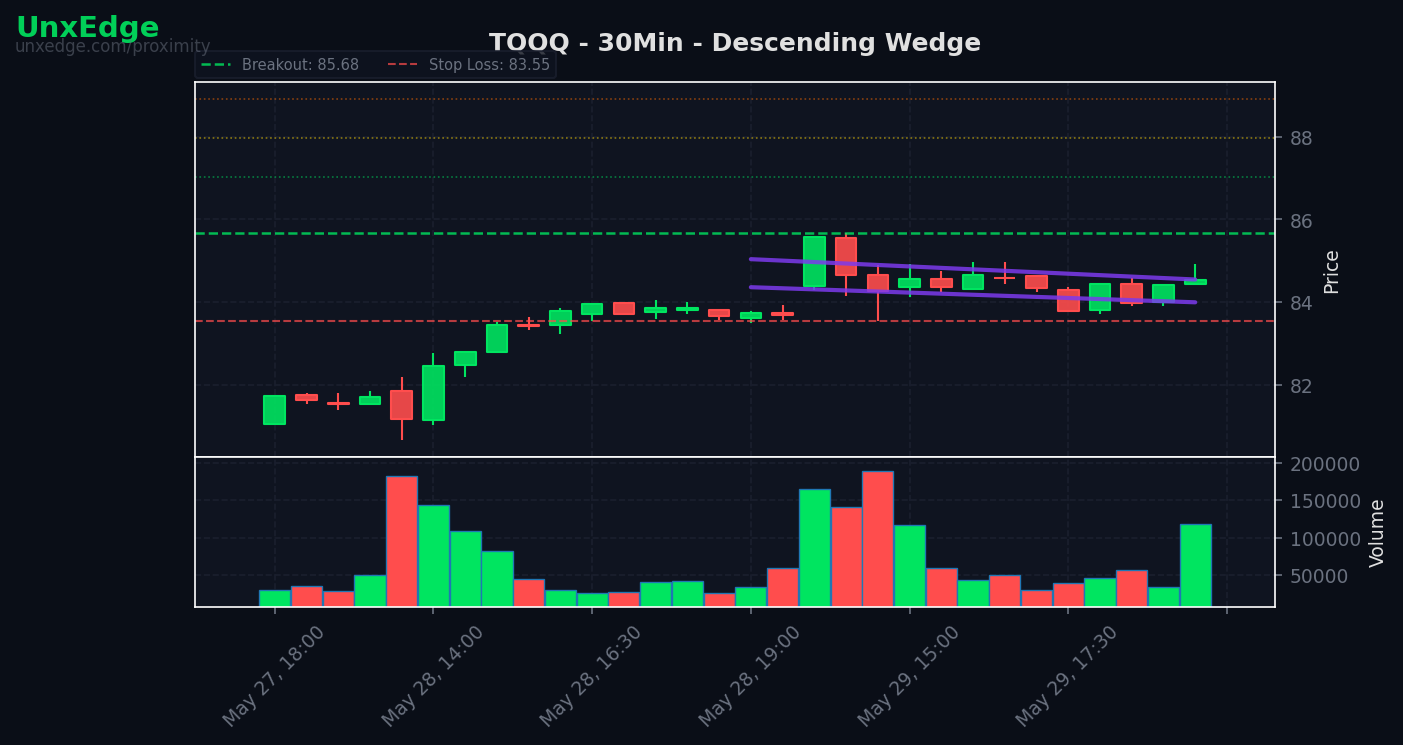
WEX took one trade and finished positive at +0.08R. The TQQQ BULL swing reversal closed with a 7.6% gain, but the more important detail is that it gave back more than half of a +21% peak. That tells us the entry logic found the move, but the exit logic let too much open profit leak. You can watch the bots trade live in the Edge Lab if you want to track how those management decisions evolve in real time.
XCEL took two trades and ended the week at -0.18R. $QQQ BULL contributed +0.06R after a strong peak that also faded before exit, while $XLV BULL lost -0.24R despite tagging TP1 at $151.02. The pattern is clear: the bots were generally able to find directional movement, but this week they struggled to convert favorable excursion into durable realized R.
What worked was upside identification in liquid index-linked names. What did not work was trade management after the initial move, especially when the market failed to trend cleanly after early strength. In a tape with selective follow-through, exits matter more than usual, and that was the difference between a decent week and a stronger one.
Best and Worst
The standout issue was not stock selection, but profit retention
The best trade on the books was WEX in TQQQ BULL at +7.6% and +0.08R, followed by XCEL in $QQQ BULL at +6.1% and +0.06R. Those are positive outcomes, but they also underline the main frustration of the week: both trades had materially larger unrealized peaks before giving back a large share of gains.
The worst trade was XCEL in $XLV BULL at -23.7% and -0.24R. What makes that trade notable is that it still touched TP1 before reversing into a net loss. That kind of outcome usually points to a tape where continuation is unreliable after the first push, and where partial monetization or tighter post-TP1 management may be more important than usual.
In short, the best and worst list says the same thing. The bots were not blind to opportunity. They were early enough to catch movement, but the week punished loose handling after entry. You can watch the bots trade live in the Edge Lab to see how those management patterns play out trade by trade.
Blind Spots
The largest missed edge came from filters that were too restrictive
The missed-trade data points to a straightforward conclusion: several filters are screening out names that still go on to produce meaningful R. The biggest drag by count was the rvol_threshold filter, but the most expensive misses came from day_pct_filter, which left 32.6R on the table in only five trades. Near any adjustment to setup grading or trigger logic, it makes sense to see live setups in the scanner and compare what is being included versus excluded.
| Pattern | Missed Trades | R Left on Table |
|---|---|---|
| rvol_threshold | 13 | +36.3R |
| spy_alignment | 7 | +18.1R |
| day_pct_filter | 5 | +32.6R |
| not_on_watchlist | 3 | +7.5R |
The practical takeaway is not that filters should be removed wholesale. It is that the current thresholds may be too blunt for this environment. Low RVOL names are still working often enough to deserve closer review, and watchlist construction needs to be broad enough to catch late-developing leaders.
Monday Outlook
FDX leads the list, while semis and high-beta tech remain active
Monday's coil list is tilted bullish, with only one bearish name in the top group. $FDX stands out on grade quality with an A+ rating and just 0.477% to its level, while ARM and $MRVL bring the highest pressure readings at 86. For traders tracking proximity and breakout levels into the open, see live setups in the scanner.
| Ticker | Grade | Bias | P | Distance | RVOL |
|---|---|---|---|---|---|
| ARM | A- | BULL | 86 | 0.906% |